It’s no secret that consumers prefer to shop in their own language – they feel safer navigating a website they can fully understand, which, in turn, makes them more willing to buy the products it offers. If you want to sell in a few different markets – or dream big and want to go global – having only one language version of your website will not cut the deal.
Still, well-translated content is only a tiny piece of the expansion puzzle – to get your business and products noticed, you need to reach your target audiences. Identifying region-specific keywords and optimising your content for multiple languages can be of great help – and make entering new markets way less difficult than it would’ve been otherwise.
At the same time, businesses also need to think beyond traditional SEO and start focusing on GEO. As more consumers rely on AI-powered search tools and LLMs to discover products, services, and brands, content needs to be structured and written in a way that these systems can easily understand, interpret, and recommend. Clear multilingual content, strong topical authority, accurate metadata, and well-organised website information all increase the chances of your business appearing in AI-generated answers and recommendations.
Multilingual SEO and GEO are a long-term investment that has the potential to take your business to a whole new level – if done right, that is. And how do you do it right, exactly?
| Read our post to find out: |
|---|
| what’s the difference between multilingual and international SEO/GEO, what should be taken into account when planning a multilingual SEO/GEO strategy, how the experts at Digibutsu do multilingual keyword research and SEO/GEO. |
What is multilingual SEO?
Before we get to the bottom of multilingual SEO, let’s start with the basics – search engine optimisation itself. SEO is a set of practices that make websites, products and services rank higher on search engine results pages (the so-called SERPs). It involves taking care of various technical aspects – such as website structure, page speed or mobile-friendliness – as well as formatting already-published content and enriching it with the most searchable keywords used by world wide web users.
Multilingual SEO is the process of optimising different language versions of your website. Even though native languages play a huge role in driving sales, translating content is not enough to guarantee success in foreign markets – especially if you want to compete with well-established domestic brands. To successfully win over a local audience, you first need to make them aware of your business’s existence. Multilingual SEO will help you do just that – and way more.
Multilingual SEO vs international SEO
Although the terms carry similar connotations (and are often used interchangeably), multilingual SEO and international SEO are two different things.
Multilingual SEO, as the name suggests, refers to optimising content for multiple languages. For example, if somebody runs a U.S.-based business, to reach the widest audience possible, they might want to make their website available in both English and Spanish. Now, this doesn’t necessarily mean that they’re trying to target all Spanish speakers from around the world – they simply want to make their products more accessible to the huge number of Spanish speakers living in the States. However, if the brand does decide to tap into South American and Spanish markets, then a different strategy will have to be adopted, which brings us to…
International SEO – an umbrella term for both multilingual and multiregional SEO. Each country has a unique audience with very specific buying patterns, and brands that want to grow their customer base and win over global audiences need to take all this (and more) into account when coming up with an international SEO strategy. Increasing the visibility of your website/content in various foreign markets is a crucial business expansion step. To successfully go global, build a solid search presence in multiple regions, and ultimately boost sales, you need localised content that’s not only well-translated, but also enriched with the most popular and region-specific keywords – only then will your target audience be able to organically find you.

What is GEO?
GEO, or Generative Engine Optimisation, is the process of optimising websites and content for AI-powered search tools and large language models (LLMs). Unlike traditional SEO, which focuses on ranking higher on search engine results pages, GEO aims to make your brand, products and services more visible in AI-generated answers and recommendations.
To achieve this, businesses need to focus on creating clear, trustworthy, and well-structured content that AI tools can easily understand and reference. Technical performance still matters, but so does content quality, consistency and topical authority – especially across different language versions of a website.
Multilingual GEO applies these practices to international markets. As more consumers use AI tools to research products and services, brands that invest in GEO can increase their visibility, build credibility, and reach global audiences more effectively. In the near future, optimising for both search engines and generative AI tools will likely become an essential part of every international digital marketing strategy.
Why are multilingual SEO and GEO important?
Paradoxically enough, attracting new customers in an era when they can buy a product with just a few clicks has never been harder. Digital marketplaces are more crowded than ever and businesses have to fight for consumer attention by making their products stand out from the endless sea of competitors. Because of that, SEO is no longer an additional boost, but an absolute must.
The same goes for GEO. As more consumers use AI-powered tools to search for products, services, and recommendations, businesses need to optimise their content not only for traditional search engines, but also for generative AI platforms and LLM tools. Brands that fail to adapt risk losing visibility in both search results and AI-generated answers.
If you sell in multiple markets, investing in multilingual SEO and GEO becomes even more important. Translating your website alone is no longer enough to compete internationally. To effectively reach local audiences, your content needs to be discoverable, relevant, and easy to understand across different languages and regions. The long-term business benefits often outweigh the initial investment costs.
Let’s take a look at some of the benefits of multilingual SEO and GEO:
- Global reach. By optimising your website for multiple languages, you can attract customers from different countries and regions, ultimately expanding your audience.
- Increased visibility. SEO improves your rankings on search engines, while GEO increases the chances of your brand appearing in AI-generated responses and recommendations.
- Improved brand awareness. Reaching audiences across both traditional and AI-driven search channels helps strengthen your global brand presence.
- Better user experience. Content tailored to the user’s language and search habits encourages deeper engagement and higher conversion rates.
- Competitive advantage. Businesses that invest in SEO and GEO are more likely to stay visible as online search behaviour continues to evolve.
Now, you can decide for yourself whether multilingual SEO and GEO are worth the effort.
SEO vs GEO: what’s the difference?
While SEO and GEO are closely connected, their goals are slightly different. Traditional SEO focuses on improving a website’s position on search engine results pages (SERPs) and driving users to click on a link and visit the website. GEO, on the other hand, focuses on increasing a brand’s visibility within AI-generated answers provided by tools such as Google AI Overview, ChatGPT, Perplexity, or Microsoft Copilot.
How AI-generated answers work
In GEO, the goal is not always to generate a direct click, but to ensure that a brand, product or service becomes part of the conversation and recommendation generated by AI. This shift changes the way online discovery works.
Traditional search engines usually provide users with a list of links ranked according to factors such as relevance, authority, backlinks, or website performance. AI-powered tools work differently – instead of simply displaying links, they analyse information from multiple sources and generate direct answers to user queries. In practice, this means that users increasingly receive summaries, recommendations, and comparisons without ever visiting a website itself.
SERP rankings vs LLM visibility
SERP rankings and visibility in LLM-generated answers do not always overlap. A website may rank highly on Google, yet still not appear in AI-generated responses if its content is unclear, poorly structured, or lacks contextual relevance. AI tools tend to favour content that is concise, trustworthy, easy to interpret and strongly connected to a specific topic or intent. In other words, ranking first on a SERP no longer guarantees maximum visibility.
This is one of the reasons why many brands are starting to notice drops in organic traffic despite maintaining strong search rankings. Users who once clicked through multiple websites now often get the information they need directly from AI-generated summaries. AI platforms reduce the need for traditional browsing by providing ready-made answers within the interface itself.
For businesses, this creates both a challenge and an opportunity. Organic traffic may decline as fewer users click on websites, but brands that invest in GEO can still maintain strong visibility by becoming part of AI-generated recommendations and responses. In many cases, being mentioned by an AI assistant may become just as valuable as appearing at the top of a traditional search results page.
Best SEO and GEO practices for multilingual websites
Localise content – don’t just translate it
One of the biggest mistakes brands make when expanding internationally is treating localisation and translation as the same thing. While translation focuses on converting text from one language to another, localisation adapts content to a specific market, audience, and cultural context.
Modern search engines and LLM tools are getting better and better at detecting content that sounds unnatural, overly generic, or disconnected from local realities. Literal translations often fail to reflect the way people actually search, speak, and consume content in a specific country. As a result, such content may struggle to rank well or appear in AI-generated recommendations.
That is why multilingual content should include local phrases, search intent and region-specific terminology. Using local examples, references, and market data also helps make content more relevant and trustworthy for both users and AI systems. In practice, a well-localised article written specifically for a German audience should not feel like a translated version of content originally created for the UK or US market.
Build topical authority in every language
Strong multilingual SEO and GEO strategies require more than translating a handful of articles into different languages. To build visibility in international markets, brands need to establish topical authority separately within each language and region.
This means creating thematic content clusters tailored to local audiences and local search behaviour. A brand may already be recognised as an expert in one country, but that authority does not automatically transfer to another language market. Search engines and AI tools both rely heavily on contextual signals, local relevance, and credibility when selecting which sources to rank or reference.
Building local authority also involves earning backlinks from regional websites, appearing in local publications, and generating mentions from trusted sources within a given market. Expert-driven content created with a specific country or audience in mind tends to perform far better than generic multilingual content distributed across every region. The stronger your local authority, the higher the chance that both search engines and AI-powered tools will treat your brand as a reliable source of information.
Structure your content for AI readability
As GEO builds on traditional SEO, content structure becomes critical because AI systems don’t browse pages like humans – they extract and summarise information. Your goal is to make content easy to interpret, break down, and reuse in generated answers.
- Use a query–answer format
This mirrors how users interact with AI tools. FAQ sections and question-based headings help LLMs match content directly to prompts. When a heading is phrased as a question and followed by a direct answer, it becomes easier for AI systems to lift that response and use it in summaries.
- Focus on concise explanations
Clear, short definitions and summaries improve both readability and extractability. Instead of long introductions, aim to answer the core question early and avoid unnecessary context before delivering value.
- Employ real user queries as inspiration
Structuring headings around actual search prompts increases relevance. Questions like “How do AI tools choose sources for their answers?” or “Why is my website not showing in AI-generated results?” reflect how people naturally phrase queries in search engines and AI tools, making it easier for your content to be matched and reused.
- Make content easy for AI to extract
Clear structure helps LLMs break content into usable pieces. Logical H1–H3 hierarchy defines relationships between topics, bullet points highlight key facts, and tables support comparisons. Short paragraphs reduce noise, while schema markup and explicit definitions remove ambiguity. The goal is to eliminate guesswork for machines interpreting your content.
- Write for structure, not just readability
Content should not only be pleasant to read, but also easy to process. LLMs favour information that is modular (broken into standalone sections), scannable (quick to navigate and understand), and semantically structured (logically organised with clear relationships between ideas).
Scaling E-E-A-T across global markets
Building E-E-A-T (Experience, Expertise, Authoritativeness, Trustworthiness) is just as important in GEO as it is in traditional SEO, especially when expanding across multiple markets.
GEO and SEO work best together here: while SEO helps you rank, E-E-A-T helps you become a source that AI systems and search engines actually trust and reference.
Work with subject matter experts
- Content written or reviewed by real specialists signals credibility
- Author profiles help validate expertise across different markets
Add local case studies
- Real examples from specific countries make content more relevant
- They also strengthen trust in region-specific contexts
Cite sources and data
- References to reputable studies and industry data improve authority
- Both search engines and LLMs rely heavily on verifiable information
Show company transparency
- Clear “About” pages, contact details, and business information build trust
- Helps both users and AI systems verify legitimacy
Publish in industry media
- Mentions and features in reputable publications strengthen authority signals
- Builds recognition beyond your own website
In GEO, AI systems often rely on signals such as brand reputation, citations, and consistency across multiple trusted sources. The more your brand appears in credible contexts at the same time, the more likely it is to be used as a reference in AI-generated answers.
Technical aspects of GEO
From a technical perspective, GEO builds on the foundations of SEO but puts even more emphasis on clarity, accessibility, and structured content delivery across languages.
A technically sound website makes it easier for both search engines and AI systems to properly interpret and reuse your content.
Key areas to focus on include:
- Correct implementation of hreflang
- Proper indexing of all language versions
- Strong crawlability across the entire site
- Fast page loading performance
- Accurate use of canonical tags
- Well-structured schema and data
- Content accessibility without reliance on JavaScript
- Clean HTML and semantic markup
In the context of AI systems, technical setup becomes even more important. Many AI crawlers still have limitations when interacting with JavaScript-heavy frameworks, which can prevent them from fully accessing or correctly interpreting content.
As a result, ensuring that key information is available in raw, server-rendered HTML is increasingly important for GEO visibility.
GEO and brand visibility
In GEO, visibility extends far beyond your own website. AI systems rely heavily on external signals and brand mentions across the web to decide what to include in generated answers. This makes brand recognition and off-site presence a key factor in how often (and where) you appear in AI-driven results.
Recognisable brands win in AI search
Well-known brands are more likely to be referenced, as AI systems tend to prioritise entities that appear consistently across the web.
Brand mentions matter as much as links
In GEO, repeated mentions across trusted sources help build relevance signals, even without direct backlinks.
Off-site presence is essential
Visibility across multiple platforms strengthens how AI systems understand and categorise your brand.
Important channels include:
- Quora
- YouTube
- Expert publications
- Industry reports
- Podcasts
- Digital PR and media coverage
How to measure GEO performance
GEO measurement is still a developing area, but there are already clear indicators that can help you assess whether your content is being surfaced in AI-generated results and responses.
Monitor brand mentions in AI tools
Check whether your brand is being referenced in responses from tools like ChatGPT, Perplexity, or Copilot for relevant queries.
Track referral traffic from AI platforms
Some AI tools and browsers send identifiable referral traffic, which can show early GEO impact.
Look at increases in branded searches
A rise in direct brand queries often indicates that users are discovering you through AI-generated answers.
Check visibility in AI Overviews
Monitor whether your content or brand appears in Google AI Overviews for key topics.
Test prompts across LLMs
Regularly run relevant user queries in different AI tools to see which brands and sources are being cited.
Practical GEO tips – a quick checklist
A simple checklist of high-impact actions that support both SEO and GEO performance:
- Write clearly and concisely
- Answer one question per paragraph
- Add FAQ sections where relevant
- Update content regularly to maintain freshness
- Build brand presence beyond your own website
- Create localised versions instead of direct 1:1 translations
- Publish original data, reports, and insights
- Ensure your content is easily citable and well-structured
- Use semantic, descriptive headings
- Develop topical authority separately for each language and market
GEO and SEO work together
GEO is not a replacement for SEO, but an extension of it. While some companies still treat AI visibility as a separate channel, in reality, both are closely connected and reinforce each other.
- Strong SEO provides a foundation for GEO, helping content become discoverable and crawlable in the first place.
- GEO builds on this by prioritising how well information can be understood, extracted, and reused by AI systems. It also puts more emphasis on content quality, brand reputation, and how clearly information is structured and presented.
In practice, the best results come from treating SEO and GEO as a combined strategy rather than separate areas.
What to base your multilingual SEO/GEO strategy on
There are several factors to consider when planning a multilingual SEO/GEO strategy. It’s essential that you do market research, localise your content, and carry out separate keyword research for each language; however, your multi-language website checklist should also include some technical aspects.
Dedicated URLs
It isn’t without reason that even Google experts recommend using dedicated URLs – they make it easier for crawlers to track down, read, and index all language versions of your content, effectively boosting your site’s positioning.
There are a few URL structure options to choose from:
- country-specific domains – website.se
- subdomains with generic top-level domains – se.website.com
- subdirectories with generic top-level domains – website.com/se/
Let’s take a look at IKEA Belgium which uses the last structure. Belgian users get to decide in which language they want to browse the Swedish giant’s website: ikea.com/be/nl/ is for Dutch, ikea.com/be/fr/ is for French, and ikea.com/be/en/ is for English.
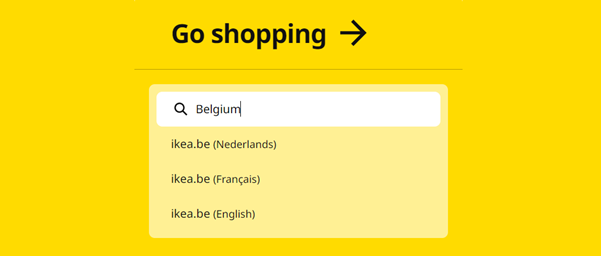
Using dedicated URLs also makes it easier to manage multiple language versions of a website, track their performance, and make improvements based on real data.
Hreflang tags
Hreflang tags are HTML attributes used by the most popular search engines to specify the language and geographical targeting of a website. They’re a crucial element of any successful multilingual SEO strategy, as they help search engines understand which language version of a website to serve to users in different regions. Without hreflang tags, search engines may display the wrong language in search results, contributing to a poor user experience and potentially damaging the website’s ranking.
Hreflang tags are particularly important for websites that have identical or similar content across multiple language versions. By indicating which version of the page is intended for which language or region, hreflang tags can help search engines avoid duplicate content issues and correctly serve the appropriate language version of a website to users.
A hreflang attribute looks like this:
| <link rel=”alternate” hfreflang=”en” hrefuse=”https://www.website.com”> |
The easiest way to add it to a website code is to put it in the <head> tag; however, if your site is available in multiple languages and has lots of subpages, this method may turn out to be very time-consuming. Another approach is to add hreflang tags to your XML sitemap – this way, you won’t have to edit every single HTML document, and you’ll be able to keep them neatly organised in a single file.
It’s vital to mention that not all search engines use hreflang attributes – for example, Bing uses an alternative tag that looks like this: <meta http-equiv=”content-language” content=”en-gb“> with en-gb standing for the language code of British English.
One-language pages
To ensure that your website is easily readable and navigable for users, it’s essential that languages not be mixed. If your content is only partly translated – or includes side-by-side translations – users may find it confusing and even sketchy, and search engine algorithms may not be able to accurately identify the primary language of the page.
At the end of the day, all SEO experts agree that sticking to only one language per page is the best way to go – nonetheless, this shouldn’t stop you from creating quality content in multiple languages.
Translated metadata
Meta titles and meta descriptions – which together make up metadata – provide the first impression and summary of a website’s content to both algorithms and potential visitors. They don’t appear on the page itself, but on Google and other search engines whenever someone looks up a certain word, phrase or webpage.
For example, this is what you see after googling “summer dresses”:
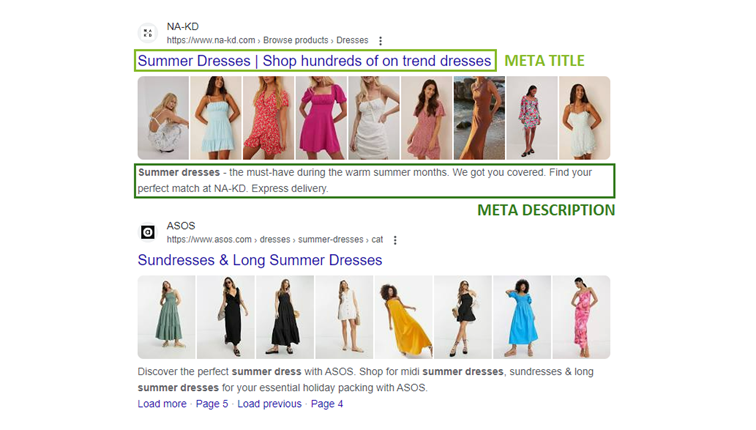
Translating metadata ensures that users with different language backgrounds can understand what the page is about, which significantly increases the chances of them visiting it. It also provides a more user-friendly experience, as consumers can quickly determine if the page is relevant to their search query.
When writing meta titles and meta descriptions, one needs to keep in mind various spatial constraints. Search engine results look different depending on what we’re using to surf the net – be it a PC, laptop, or mobile device. The ideal lengths for a meta title and meta description used to be 60 and 160 characters, respectively, but nowadays, it’s pixels that matter the most. To make sure that your content is readable on different-sized screens, you can preview it using Chrome’s mobile simulator tool.
Multilingual keyword research done by native speakers
When it comes to multilingual keyword research, properly identified and topic-specific keyphrases aren’t the only thing that counts. Knowledge of local cultures greatly helps put everything into perspective, making it easier to verify the relevance of given keywords. Even the best SEO experts out there don’t know the ins and outs of every single market in the world – and if your business partner doesn’t rely on native speakers’ help with keyword identification, you could be missing out on great sales opportunities.
Native speakers have a better understanding of the nuances and context of their language, including slang, regional variations, and idiomatic expressions; therefore, it’s easier for them to identify more accurate keywords that are likely to be used by a given target audience. They’re also aware of various cultural and social factors that influence language use, which allows them to better analyse the intent behind certain search queries. Native speakers provide a more up-to-date perspective on which keywords are the most relevant – and more likely to produce great results. At Digibutsu, keyword research is always done from scratch for each market and then verified by native speakers of the language your content is translated into.
Local and global content strategy
We’ll risk sounding like Captain Obvious here, but when it comes to expansion, the most important step involves doing market research. Let’s say you have an Italian clothing brand. Last year, you reported record sales, which made you want to enter the Norwegian market. Your brand, as a whole, might do relatively well, but your best-selling product – a gorgeous sun hat – might not be the most sought-after piece of clothing in the North. To avoid any potential failures, before entering any new market, you should always narrow down your target audience and choose which products and/or services actually stand a chance of grabbing customers’ attention.
After you’ve done that, it’s time to get through to your target audience by localising your content. Doing so will gain you credibility, build customer loyalty, and increase brand recognition. Both small businesses and e-commerce giants often create multilingual content by preparing an English master version and then localising it into other languages. To people outside the translation industry, this may seem like a game of Chinese whispers, but in reality, it doesn’t have to mean that your content is going to end up sounding weird or distorted. You can avoid mistakes and misunderstandings by creating a brand book or a style guide explaining your brand’s preferred tone of voice and formatting style, as well as containing any reference materials which translators might find useful when transcreating content that’s in line with your original intent.
By taking these factors into consideration, companies can create effective multilingual content that resonates with their target audience and helps drive business growth.
“Forgotten” search engines
There’s no doubt that optimisation for Google’s algorithm should be one of the top priorities for any website looking to increase visibility, reach new customers, and make more profit – after all, the engine dominates the industry and drives the majority of web traffic. However, if you want to achieve the best results, it’s important not to disregard search engines other than Google, which hold a relatively small (but still significant!) market share – such as Bing, Yahoo!, Baidu, or Naver.
In China and South Korea, Baidu and Naver are the most used search engines, respectively – and anyone who plans on selling products in those markets should be aware of the engines’ popularity. When it comes to the above-mentioned countries, optimising your content solely for Google might produce unsatisfactory results.
Search engines that are less popular (at least by Western standards) have different algorithms and ranking factors, which means that your SEO strategy may require a different approach. Still, tailoring your SEO efforts to the specific requirements of each search engine is definitely worthwhile, as it will help you reach more people and increase visibility in certain regions or industries.
Multilingual SEO/GEO and keyword research at Digibutsu
Are you struggling to make your website visible to users who speak different languages? Are you looking for ways to give your products a boost on Amazon? Digibutsu is here to help!
Our team of experienced SEO and GEO specialists will make sure that your content and/or products gain maximum visibility – regardless of the language or location. We tailor our SEO and GEO strategies to each client’s unique needs and business goals, conducting keyword research separately for each market and taking into account local language and cultural nuances.
Don’t let language barriers hold your business back and contact us today to learn more about our comprehensive solutions and reach a wider audience. The whole world is at your fingertips!
FAQ
Is it expensive to do multilingual SEO?
The cost of multilingual SEO varies depending on the number of languages and the scope of the project. If you have to work with several agencies to cover each language separately, it can be a bit pricey. It’s best to find an all-in-one SEO agency that offers optimised solutions and can help you save both time and money.
Is multilingual SEO worth the effort?
If you’re looking to enter foreign markets and attract more customers, multilingual SEO is definitely worth the effort. By optimising your website for multiple languages, search engines, and marketplaces, you can gain a competitive edge, build customer loyalty, and boost your rankings in different countries and regions.
Why is multilingual SEO important?
Multilingual SEO makes it easier for businesses to tap into new markets. Optimised multilingual content increases the visibility of your business, products, and services, helps build credibility, and improves conversion rates – all of which will eventually lead to higher revenues.
Is a multi-language website good for SEO?
Multi-language websites allow businesses to reach more people and target specific audiences from all around the world. Multilingual content makes customers feel more confident when doing online shopping, which, in turn, leads to deeper engagement, increased website traffic, and higher search engine rankings.
Will GEO replace SEO?
No. GEO does not replace SEO – it builds on it. Strong organic visibility still plays an important role in strengthening domain authority, improving brand recognition, and generating the types of signals that AI systems rely on when selecting information to include in responses.
Is translating your website enough to increase visibility in AI search?
Not really. AI models are getting better at spotting content that’s been directly translated or that doesn’t reflect local context. To perform well, content needs to feel natural for a specific market – aligned with local language, user intent, and expectations.
